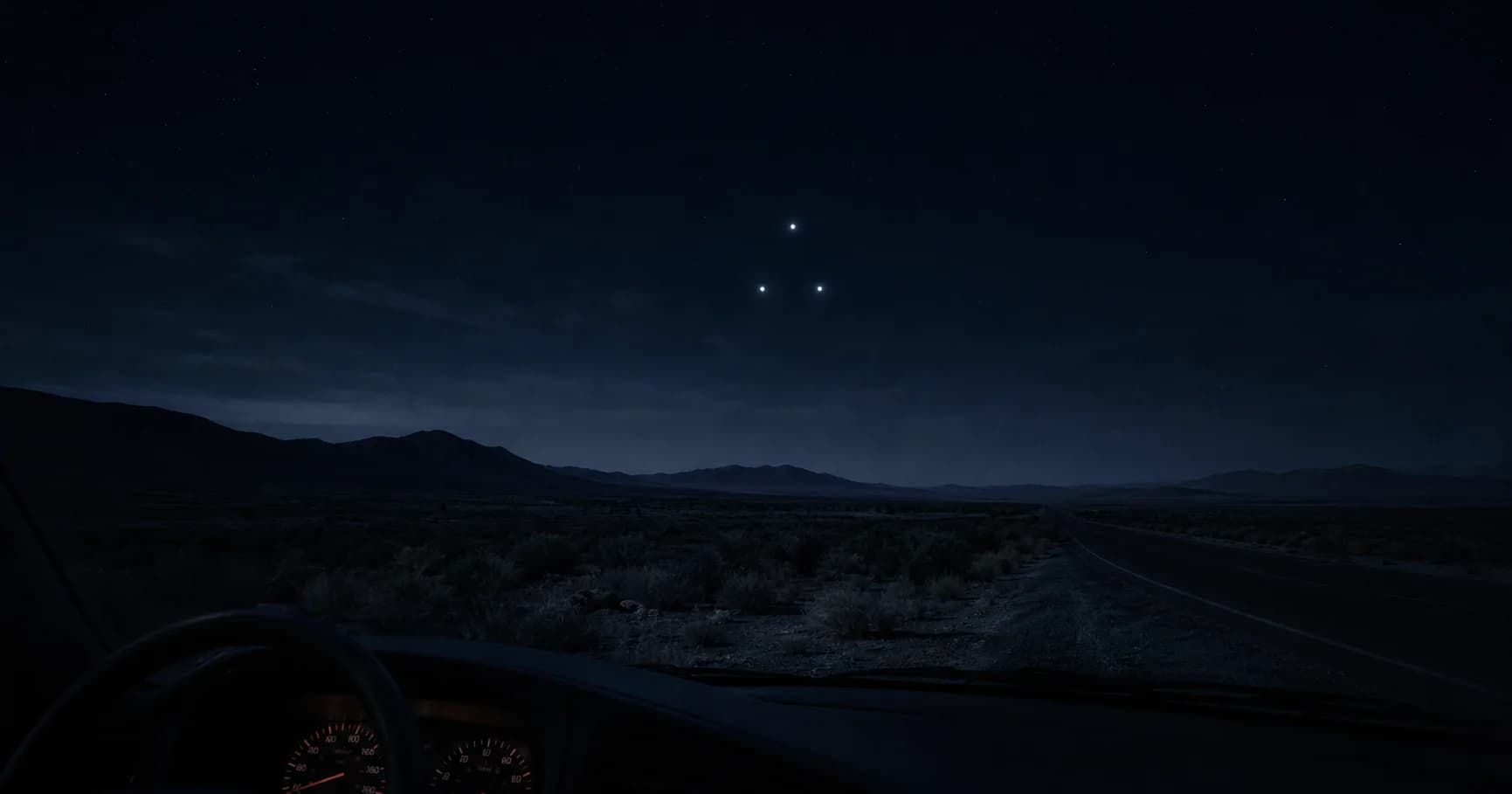

At 10:42 last night, every star above Bellwether moved into a straight line.
I was closing the city planetarium when the motion sensor on our roof telescope triggered. The software highlighted seventeen objects crossing the northern sky. I assumed satellites until they stopped.
Then the rest of the stars moved.
Continue readingHide remaining accountAbout 6 min remaining
Then the rest of the stars moved.
Not just the bright ones. Every visible point slid silently across the darkness, arranging itself into rows and columns. Constellations stretched apart. The Milky Way narrowed into a pale stripe. Within thirty seconds, the sky became a perfect grid.
The moon remained where it was.
It looked trapped between the lines.
I called my director, Seline, and opened the roof hatch. People were already standing in the parking lot, pointing upward. Cars had stopped in the road. Dogs pressed themselves beneath porches and refused to look at the sky.
Each star appeared identical now. Same brightness. Same white color. Same distance between neighbors.
Our telescope could not focus on them. At every setting, the points remained sharp. Ten miles. One mile. Ten feet.
They were not far away.
The grid was an image placed over the town.
We aimed a laser upward. The beam ended at the nearest point instead of fading into space, forming a bright red spot on darkness. When Seline moved the laser, something behind the grid followed it. A second red point appeared beside ours, copying the motion with a slight delay. Then it began moving first.
At 10:49, the points began blinking.
One row at a time, west to east, like a scanner. When the wave of darkness passed over us, every phone in the parking lot restarted. Car alarms sounded. The planetarium projector turned on by itself and cast the same grid across the dome.
A message appeared beneath it.
CALIBRATION: 18,206 UNITS
Bellwether's population was 18,206.
Seline arrived carrying an old film camera. She said digital sensors were reading only a normal sky. On phone screens, stars remained scattered in familiar constellations. Through our eyes, the grid covered everything.
Her first photograph developed blank.
The second showed the town from directly above.
We could see ourselves in the planetarium parking lot, tiny and sharp. The image had been taken from somewhere overhead, but the angle was impossible. Clouds covered half the sky, and no aircraft appeared on radar.
A white dot had been printed over each person.
My dot was centered on my forehead.
The stars blinked again.
This time, one light stayed dark.
Across the street, an elderly man collapsed. Paramedics found no pulse. The population counter on the dome changed to 18,205.
The dark point brightened.
Seline whispered, “It counted him.”
At 11:03, the grid began descending.
You could see it only at the edges of buildings. Stars that had seemed overhead passed behind the radio tower, then behind the courthouse roof. The sky lowered like a sheet.
People ran indoors. It made no difference. White points appeared on ceilings, visible through concrete and wood. Each followed a person with perfect accuracy.
When I moved, my point moved.
When I covered it with my hand, a smaller dot appeared on the back of my hand.
The city emergency network failed. Radios transmitted a soft clicking rhythm. Seline recorded it and slowed the audio. The clicks became names.
Every person in town, spoken alphabetically.
At midnight, clocks stopped.
Not at the same displayed time. They froze wherever their hands happened to be. People continued moving, but recordings showed empty rooms. Security footage skipped from 11:59 to 1:17 without capturing the interval.
We lost seventy-eight minutes.
During that missing time, circles appeared in the streets.
They were twelve feet wide, pressed into asphalt and grass as if immense lenses had touched the ground. Anything inside them had been flattened without damage. Cars were compressed into sheets of metal. Trees became perfect green disks.
People standing within the circles were gone.
Their stars remained.
The population counter rose.
18,241.
The grid was not counting residents anymore.
It was adding what it collected.
We moved into the planetarium's underground archive. There were fourteen of us: staff, visitors, and families from nearby houses. The white points followed us down. They shone through shelves and concrete, each resting above a head.
One belonged to a little girl named Eva. She asked why her star had another star inside it.
We looked closer.
Her white point was an opening. Through it, I saw a room on the other side of the sky. Tall figures leaned over a black surface. Their faces were clusters of moving lights. One held a tool shaped like a compass needle.
It lowered the tool toward Eva's star.
Seline pulled her away.
The point followed.
A thin white line emerged and touched the floor where Eva had been sitting. Concrete peeled upward in a perfect circle, exposing the room beneath ours. The line continued through it, cutting deeper without heat or sound.
They were sampling the town.
The grid blinked faster. Names on the radio stopped being alphabetical. They began listing us by location.
ARCHIVE LEVEL. ROW THREE. FOURTEEN UNITS.
The voice was not speaking English. Every radio produced different sounds, yet everyone understood the same meaning.
We scattered.
The points separated and pursued us through the dark. One man entered a storage cabinet. His star shrank to a needle, passed through the steel, and widened inside. The cabinet folded flat.
The counter increased by one.
Seline led Eva and me into the projection chamber. The old mechanical star projector stood in the center, a black sphere pierced with thousands of tiny holes.
Seline switched it on.
Our artificial stars filled the dome above.
The real grid hesitated.
For the first time, the white points stopped tracking us. They moved toward the projected constellations, trying to assign one light to each false star.
The population counter climbed wildly.
Twenty thousand. Fifty thousand. A million.
The system was counting our projection.
Seline increased the brightness until the old bulb screamed. The grid expanded to match the dome. Outside, witnesses said the stars raced apart in every direction.
Then the projector burned out.
The dome went black.
Seline and Eva were gone.
Two new holes had appeared in the projector sphere.
Light shone through them although the bulb was dead.
I am alone in the projection chamber now. Dawn should have arrived two hours ago, but the sky outside remains black. The grid has stopped descending just above the rooftops. Individual stars are the size of windows. Through them, I see the bright room and the clustered faces watching.
The counter covers the planetarium dome.
CALIBRATION COMPLETE.
SCALE UNKNOWN.
One point follows me. Inside it, Seline and Eva stand on the other side of the sky. They are pounding against something transparent. Their mouths form the same warning:
DO NOT LET THEM FOCUS.
The telescope has begun turning toward me.
Its motors are disconnected. Its lens reflects an eye made of thousands of stars.
If the night sky above you forms a grid, go somewhere with as many lights as possible. Give it more points than it can count. Do not stand beneath a dark square.
And if one star follows when you move, do not look through it.
Something on the other side is adjusting the focus.