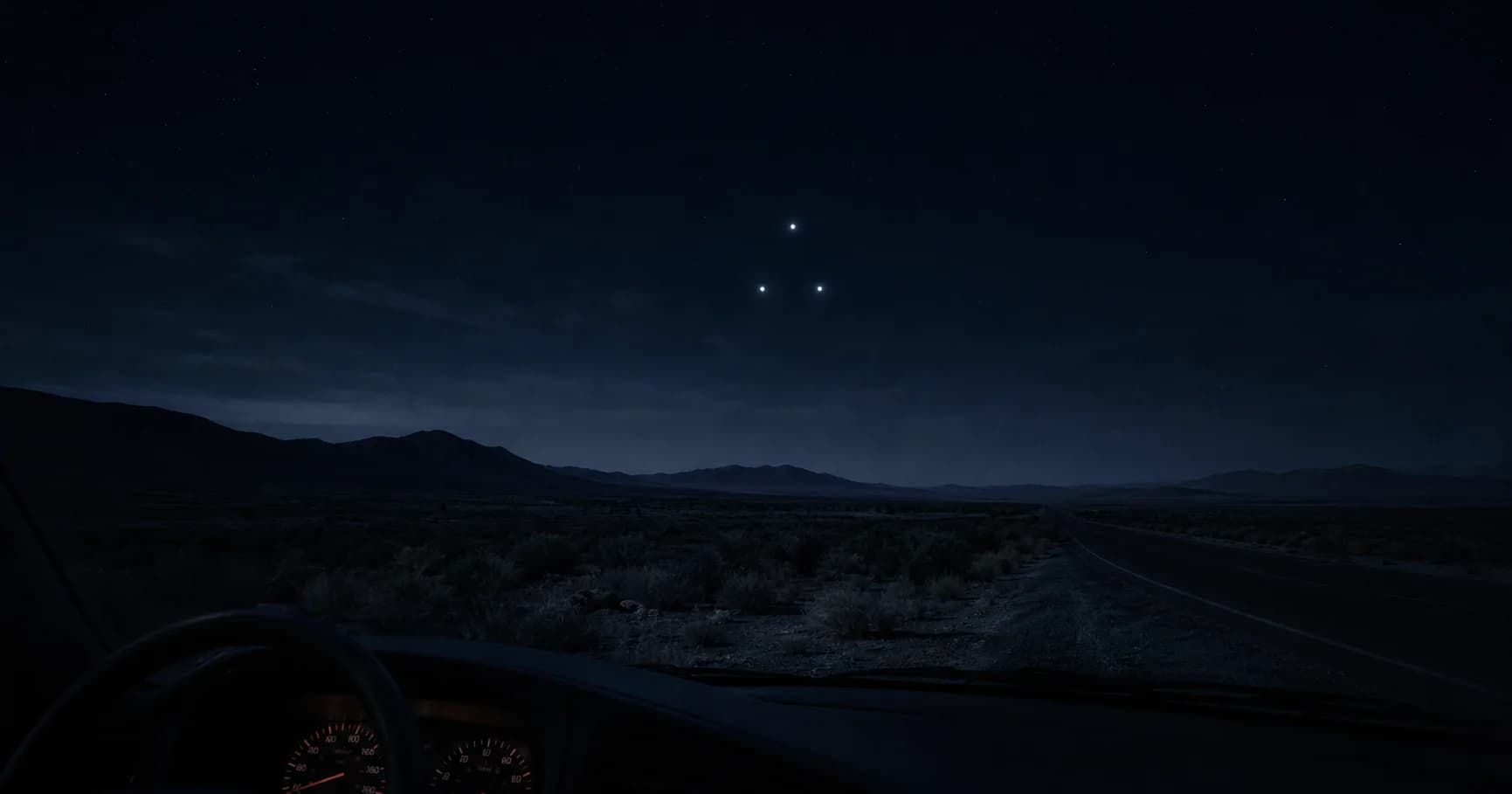

The object was nine hundred million miles away when we first focused on it. Six hours later, it cast a shadow across our dome.
I was a postdoctoral astronomer at Grayhaven University Ridge Observatory, studying stellar occultations beyond Saturn. The work was precise and unglamorous. We watched distant stars blink as small objects passed in front of them, then used the timing to estimate size and orbit. Most discoveries were numbered rocks too dark to photograph directly.
The object we designated GR-731 was different because the star behind it did not blink.
Continue readingHide remaining accountAbout 6 min remaining
The object we designated GR-731 was different because the star behind it did not blink.
It narrowed.
The star's light bent around a silhouette shaped like a folded insect or a hand with too many joints. Our first exposure showed only four dark pixels. I requested a second at twice the focal length. The next image showed eight pixels across.
That should not have happened. Magnification enlarges the image, not the object. When I reduced both exposures to the same scale, GR-731 remained twice as wide in the second. Its angular size had genuinely doubled.
My colleague Ren Park calculated a fresh distance from parallax. Four hundred fifty million miles.
Exactly half the first estimate.
We blamed calibration and repeated the observation at four times magnification. GR-731 appeared four times larger and two hundred twenty-five million miles away. It had crossed a distance greater than the orbit of Jupiter during an exposure lasting ninety seconds without heat, exhaust, or any measurable change in velocity.
It had not traveled between images. It had simply become nearer when we asked to see more.
Ren told me to stop the sequence. Our graduate assistant, Lewis, had already exported a crop to his laptop. He pinched the trackpad to enlarge it.
The observatory lights dimmed.
A fresh exposure showed GR-731 at one hundred twelve million miles. New details emerged: a central cavity ringed by smooth plates, each reflecting a different star field. Inside the cavity, three pale points opened and turned toward Earth.
Every camera in the building focused by itself.
Phones woke in pockets. Security cameras rotated toward the dome. The guide scope, disconnected for maintenance, moved its lens against gravity. On each screen, the four original pixels appeared and began sharpening.
We killed the observatory network, but Lewis had posted the image to a private astronomy forum ten minutes earlier. Seven people downloaded it. Three replied with enlarged versions. An amateur observer in Chile reported the object near Mars. Someone in Finland sharpened the contrast and found what looked like fingers folded along its underside.
Each act of resolution cut the distance.
By 10:40 p.m., GR-731 had crossed the Moon's orbit. Nothing appeared to the naked eye. Through a finder scope, however, it was larger than the Moon and blacker than the sky around it. Its outline changed with the instrument. Binoculars showed wings. A digital camera showed human arms nested elbow inside elbow. Our main telescope showed an opening filled with wet, reflective eyes.
The eyes reflected the people observing them, but from behind.
Ren looked away from the monitor. In the image, her reflection kept watching.
We covered every lens and powered down the instruments. The servers continued writing new image files to storage. Each file was larger than the last. Their timestamps advanced by seconds, then reversed. One folder contained photographs dated the following morning: the dome split open, frost coating the control room, our chairs arranged in a circle around a black shape too detailed for the camera to contain.
Lewis began deleting files. Every deletion restored another copy from nowhere. The recovered images included angles no telescope had captured: the object below the horizon, inside the dome, hanging above Lewis's bed at home.
The radio telescope down the ridge called us. Its receivers had detected no transmission, only an absence moving across frequencies. When the technician amplified that gap, GR-731 appeared on their spectrum display and the measured distance halved again.
It did not require light. Any attempt to extract detail from uncertainty brought it closer.
At 11:16, a shadow crossed the dome.
The sky was clear. There was no visible object overhead, but the shadow had limbs. They unfolded across the white panels and gripped the building. Metal popped under pressure. A layer of frost spread down the inside walls, forming tiny branching figures that all pointed toward the telescope mirror.
Ren remembered an experiment from information theory: if greater resolution reduced distance, then deliberate loss of information might increase it. Not looking away. Not deleting. We had to make the image objectively smaller and less detailed while still treating it as the same observation.
We took the earliest four-pixel exposure and reduced it to one pixel. The shadow loosened slightly.
We embedded that pixel inside a larger black frame, saved the result, then reduced the new image again. The parallax feed jumped from eight hundred miles to sixteen hundred. We repeated the process. One pixel became one quarter of a pixel, then a statistical average, then a rounding error.
Outside, something scraped along the dome as it receded. Each reduction sent the measured distance doubling: three thousand miles, six thousand, twelve. The frost figures blurred into smears. The impossible image files on the server lost detail until they became black squares.
Then Lewis's phone chimed.
The astronomy forum had automatically generated a high-resolution preview from his original upload. Hundreds of users had opened the thread after someone titled it PROOF OF FAST-MOVING OBJECT. They were zooming, sharpening, tracing edges, and posting interpretations. Distance fell faster than we could reduce it.
GR-731 reached the observatory roof.
The dome dented inward beneath invisible weight. On our covered monitor, a live camera view appeared anyway. The thing crouched twelve feet above us. Its body was made of nested versions of itself, each smaller shape looking through the eyes of the larger. The central cavity opened. Inside it was not a mouth but the control room, with us seated exactly as we were.
In that smaller control room, another version of the object hung overhead. Inside that one was another room. The image continued inward beyond the screen's resolution.
It was using magnification to build a path made of repeated observers.
Ren disconnected the primary mirror supports. The eight-ton mirror tilted forward and shattered across the dome floor. Thousands of fragments reflected the covered sky. For one awful second, each shard contained a separate GR-731 at arm's length.
Then I aimed the observatory's projector downward and loaded our one-pixel image. I projected it onto the broken mirror, photographed the scattered projection at the lowest possible resolution, reduced that photograph, projected it again, and repeated. Each generation lost not only pixels but agreement about where the object was. Its copies diverged. Distance estimates became negative, imaginary, undefined.
The thing above us unfolded in contradictory directions.
Every mirror shard showed it receding toward a different sky. The dome released with a boom. Frost evaporated. The black absence in the radio spectrum narrowed to nothing. Our final file contained a single gray pixel with no usable coordinates.
At 1:03 a.m., the stars returned.
The university closed the observatory after blaming a structural failure and cyberattack. Lewis removed the forum post, and moderators deleted the copies they could find. Ren refuses to use optical devices now. She covered every mirror in her apartment and reads without glasses.
I thought our recursion had scattered GR-731 beyond definition. For months, no survey detected it. Then an image-restoration company contacted the university. Their crawler had found corrupted astronomy data in an old web cache and used it to demonstrate a new enhancement system.
They sent me the result this morning.
The original four pixels are now a detailed portrait.
It shows me sitting at my desk, reading the email. Behind my chair, something with folded limbs is leaning toward the screen. Each reflective eye contains a smaller image of whoever is looking at it.
I have not opened the attachment.
The preview is sharpening by itself.